
Cultural heritage · Thailand
Wat Phra Mahathat Woramahawihan, Nakhon Si Thammarat
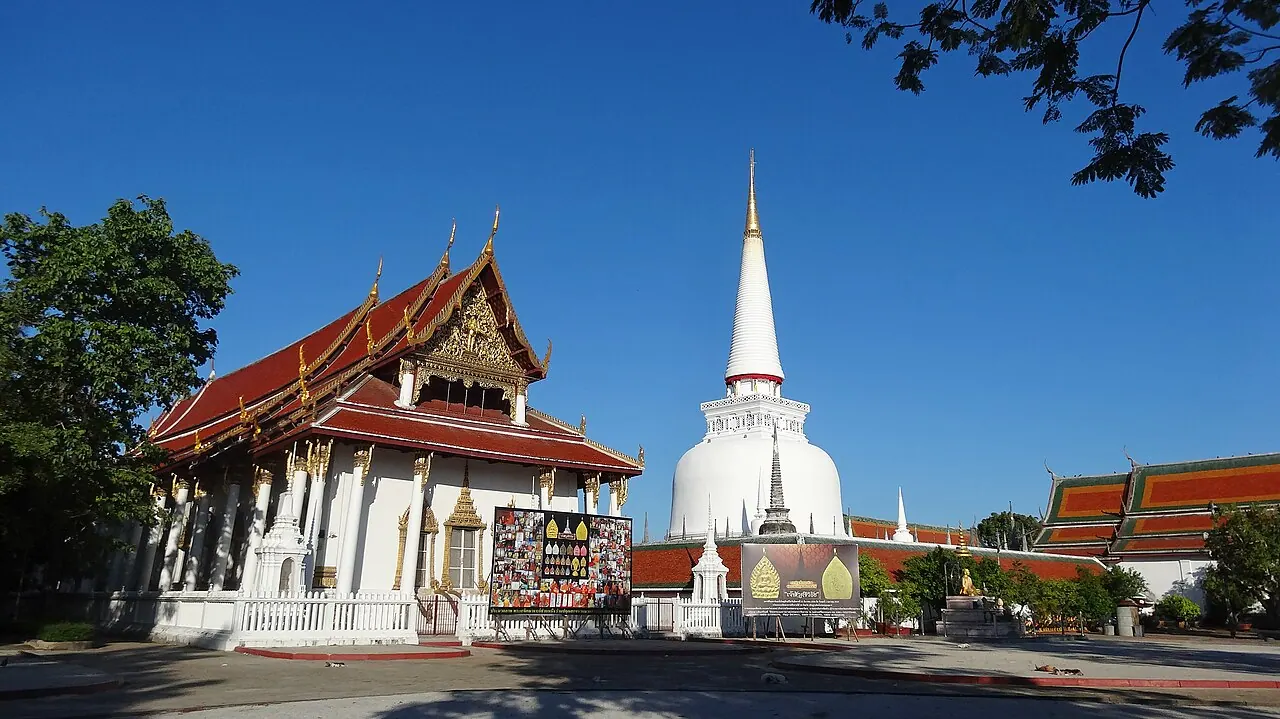
Wat Phra Mahathat Woramahawihan (or Phra Mahathat monastery), located in Nakhon Si Thammarat Province in Peninsular Thailand on a narrow ridge between the Pacific and Indian oceans, has served as a major regional Buddhist centre since its founding in the 8th century. Benefiting from the transoceanic trade networks, the monastery was influenced by various religious and architectural traditions including Brahmanism, Hinduism, Mahayana Buddhism and Theravada Buddhism from northeastern India, central Java, Sri Lanka and the Mon region of southern Myanmar. These influences have been integrated into its religious buildings, rituals and cultural traditions. Its distinctive artistic and architectural expressions have exerted a wide-ranging and enduring influence throughout Thailand and across Southeast Asia. The religious and local traditions have continued at the monastery for more than 1,500 years, including the Nakhon Si Thammarat chronicle tradition, the annual cloth-wrapping ceremony for the Great Reliquary and the Nora dance drama.
Heritage at a glance
- First inscribed
- 2026
- UNESCO region
- Asia and the Pacific
- Selection criteria
- (ii)
- Property area (hectares)
- 5.356
Why this place matters
UNESCO’s assessment of its heritage significance, adapted in formatting from the source dataset.
Brief synthesis
Wat Phra Mahathat Woramahawihan (or Phra Mahathat monastery) is a Theravada Buddhist monastery located in the Nakhon Si Thammarat Province in Peninsular Thailand, a crucial trade crossroad between the Indian and Pacific Oceans. Founded in the 8th century, where a Hindu shrine once stood (5th-8th centuries), the monastery has been a regional religious centre ever since. The complex is centred on the Great Reliquary of Buddha in the form of a mandala (Buddhavasa), flanked by the residential quarters of the monks (Sanghavasa) to the north and south according to the Tipiṭaka (Pali Canon). It comprises religious buildings, including the Great Reliquary with satellite stupas, various functional structures, two Bodhi tree shrines and the sacred Crystal Beach, on which the monastery is built, as well as residential buildings in the monastery.
Bearing witness to the fusion of Brahmanism, Hinduism and the Mahayana and Theravada Buddhism of South and Southeast Asia, the combined artistic and architectural expressions found at Wat Phra Mahathat, imbued with local and religious traditions, had a lasting influence on building construction in the region.
Criterion (ii):
Wat Phra Mahathat is an exceptional testament to the interchange of human values. The Great Reliquary demonstrates the influence of Brahmanism, Hinduism and the Mahayana and Theravada schools of Buddhism, originating from Pala art in Nalanda, Central Javanese art, Sri Lankan art and Mon art from southern Myanmar. In turn, the combined architectural style of the Great Reliquary has exerted a profound influence on subsequent religious buildings in Thailand, Malaysia and beyond.
Criterion (vi):
As the testimony to diverse belief systems and the spiritual centre of Nakhon Si Thammarat, Wat Phra Mahathat is the heart of living religious traditions with artistic and literary works of outstanding universal significance, such as the Nora dance drama and the local chronicles. These traditions vividly represent the relationships between this sacred site and its surrounding communities and inspired other monasteries and communities in Thailand and beyond.
Integrity
The boundaries of the property follow the outline of Wat Phra Mahathat, which is large enough to include all the attributes conveying the Outstanding Universal Value. The mandala plan of the Great Reliquary complex, the Tipikata layout of the monastery, all the religious buildings and the Crystal Beach on which the monastery was established, are all included in the property. Important views and settings are protected by the buffer zone. The property is in a good state of conservation, and well-maintained by the monastery and local communities, as well as relevant authorities.
The modern urban development has no negative impact on the area inside the monastery, and all factors affecting the property are under control.
Authenticity
The property retains a high level of authenticity in terms of location, function, form, materials, traditions, and spirit. The location and function of the monastery remain unchanged since its establishment in the 8th century. The layouts of the Great Reliquary and the monastery have been authentically preserved. The forms and traces of architectural and artistic expressions of different origins since the 8th century have been preserved at the Great Reliquary stupa.
Traditional materials and techniques have been used in the past restorations, which preserved the original forms of religious buildings. The living Bodhi trees testify to the authentic roots of their origin. The sacred sand ground is still preserved. The Phra Mahathat Monastery is still active, continuing its associated traditions.
Protection and management requirements
The property is inscribed on the List of National Ancient Monuments and has been registered in the Royal Gazette in 1936 and 2024. It is protected under the Act on Ancient Monuments, Antiques, Objects of Art and National Museums (currently under revision) and the Sangha Act, which both provide the highest level of protection at the national level. The buffer zone covers the important views and settings and is protected by a comprehensive framework of legislations and planning regulations at the provincial and municipality levels. Within the buffer zone, a height control zone has been demarcated for protecting the important views.
The management framework comprises institutions from national, provincial and municipal levels, and is featured by a combination of traditional and State management, with active participation of local communities. The management activities are guided by the Management Plan of Wat Phra Mahathat (2026-2030) and are supported by the Disaster and Human-Induced Risk Management Plan for the Cultural World Heritage Site, Wat Phra Mahathat Woramahawihan, Nakhon Si Thammarat Province, Thailand, as well as Tourism Management Plan for the Conservation of Cultural Heritage: Wat Phra Mahathat Woramahawihan (2026-2030) developed specially for the monastery.