Slovakia has mastered much of the difficult transition from a centrally planned economy to a modern market economy. The DZURINDA government made excellent progress during 2001-04 in macroeconomic stabilization and structural reform. Major privatizations are nearly complete, the banking sector is almost completely in foreign hands, and the government has helped facilitate a foreign investment boom with business-friendly policies, such as labor market liberalization and a 19% flat tax. Foreign investment in the automotive sector has been strong. Slovakia's economic growth exceeded expectations in 2001-05, despite the general European slowdown. Unemployment, at an unacceptable 15% in 2003-04, dropped to 11.4% in 2005, but remains the economy's Achilles heel. Slovakia joined the EU on 1 May 2004.
Slovak natural resources include brown coal and lignite; small amounts of iron ore, copper and manganese ore; salt; arable land
landlocked; most of the country is rugged and mountainous; the Tatra Mountains in the north are interspersed with many scenic lakes and valleys
Slovak religion is Roman Catholic 68.9%, Protestant 10.8%, Greek Catholic 4.1%, other or unspecified 3.2%, none 13% (2001 census).
Natural hazards in Slovakia include NA.
Travel Advice for Slovakia
SlovakiaThis advice has been reviewed and reissued with an amendment to the Health section (EHIC). The overall level of the advice has not changed.
SUMMARY
- Slovakia shares with the rest of Europe a threat from terrorism. Attacks could be indiscriminate and against civilian targets.
- Most visits to Slovakia are trouble-free. The main type of incident for which the majority of British nationals require consular assistance is petty theft.
- Before travelling to Slovakia, you should ensure that your passport is in a presentable state. The Slovak authorities can refuse you entry if your passport is worn or damaged, or looks as if it has been tampered with. It is also advisable to carry a photocopy of your passport, even if travelling as part of a group.
- We strongly recommend that you obtain comprehensive travel and medical insurance before travelling. You should check any exclusions, and that your policy covers you for the activities you want to undertake. Please see Travel Insurance
SAFETY AND SECURITY
Crime
In Bratislava there is a growing incidence of petty theft. Pickpockets operate around the main tourist areas, and foreigners are easily identified and targeted. You should take sensible precautions against bag snatching and mugging. Do not leave valuables unattended. If you must leave valuables in your car please ensure that cannot be seen from outside the vehicle, but ideally take the valuables with you. There were a few cases in 2005 in Bratislava where men had been offered “spiked” drinks by women, and had woken up several hours later with all their valuables gone. So far, we have no reports of women having been targeted in this way.
There have been a few several reported cases of theft of valuables at the Zlaty Piesky camping area in Bratislava. We recommend particular caution when camping.
More serious crime does happen in Slovakia but is not targeted at tourists or visitors and tends to be a result of disputes between warring criminal factions.
Road Safety
Make sure that you have valid motor insurance for your car. Right-hand drive cars can not normally be registered in Slovakia, which makes it very difficult to obtain insurance for those who intend to settle or remain in Slovakia to work.
You can drive on a UK driving licence for up to 6 months.
Children under the age of 12 must not sit in the front seat of moving vehicles.
Although reasonably good, many main roads have only a single carriageway in each direction making overtaking difficult. Road markings are difficult to see in poor weather.
The standard of driving is not high and can be aggressive, with drivers often going too fast (especially in bad weather), pushing into dangerously small gaps, tailgating and overtaking with little regard for other road users. Drive defensively and allow yourself more "thinking time". Specifically, beware of oncoming cars overtaking on your side of the road (particularly on bends and hills). Older low-powered cars and trucks travel very slowly; be careful not to overestimate their speed. Most motorways should only be used if you have a motorway sticker (vignette) stuck to the vehicles’ windscreen. The vignettes are available for 15 days or a whole year and can be purchased at border crossings, petrol stations or Post Offices.
In winter, equip your car for severe driving conditions: use winter tyres, and if travelling outside Bratislava carry extra warm clothing, hot drinks in a thermos-flask, sacking (to help give tyres purchase in slippery conditions) and a shovel. Although winter tyres are not compulsory in Slovakia, where an accident occurs and one vehicle has normal tyres on their vehicle the official presumption is that they are at fault. From 15 October to 15 March all vehicles must have their headlights switched on, regardless of the weather and if they are in a town or out in the country. It is also mandatory during the winter period to have snow chains in the car available for instant use.
Please note that drivers with any trace of alcohol in their body will be arrested. There is no permitted level other than 0%. If you are involved in an accident while driving the Police will give you a breath test regardless of who is to blame.
Skiing and Hiking
If you intend to ski or hike in the various Slovak mountains and get into difficulties you should be aware that since 1 July 2006, if the Slovak Mountain Rescue Service (HZS) is called out, you will be required to meet their full costs. The costs could range from SKK 3,500 (£60) to SKK 300,000 (£5,200) depending on the size of the operation. Any person ignoring/violating HZS commands or laws will be liable to a fine of up to SKK 100,000 (£1,700). Skiers and mountain visitors are recommended to ensure they have sufficient insurance to cover any rescue costs and to take heed of any instructions issued by HZS.
LOCAL LAWS AND CUSTOMS
While in Slovakia, you will be subject to its laws and regulations. All those who violate Slovak laws, even unknowingly, may be arrested and expelled or imprisoned. Some important rules include:
-
You must carry your passport with you at all times as identification - keep it safe, e.g. in a zipped up pocket or secure bag, and keep the details separately in case you do lose it. Remember to enter/revise next of kin details into the back of your passport.
-
If you plan to stay in Slovakia on a long-term basis, i.e. to work or live, you should register with the Police within three days of arrival. You will need your passport, two photographs, a small fee of SKK 100-200 (£2 – 4) and proof of accommodation in the form of either your letter of ownership, if you own the property, or lease agreement accompanied by the letter of ownership from the owner of the property. You have an option to apply for a Slovak “green card”, which can be used as proof of you ID, while keeping your passport in a safe place.
-
Taking photographs of anything that could be perceived as a military establishment or somehow of security interest, may result in problems with the authorities.
-
Do not get involved with drugs in any way. The penalties for smuggling, possession and use of drugs are severe.
ENTRY REQUIREMENTS
Visas are not required for British citizens to enter Slovakia. As a British passport holder there is no minimum length of remaining validity needed. Nevertheless it is recommended, wherever possible, the passport is valid beyond the length of your planned stay in Slovakia. For further information please check the website of the British Embassy, Bratislava: Slovak representation in the UK
British Overseas Territories citizens, British Overseas citizens, British nationals (Overseas), British subjects and British Protected persons should contact the nearest Slovak Embassy to determine if there is a requirement for a visa to be obtained. This also applies to Third Country Nationals who hold residence permits in the UK. Depending on the format of that residence permit, a visa for Slovakia may be required. The Ministry of Foreign Affairs of the Slovak Republic has a website: http://www.mzv.sk which will help to locate your nearest Slovak Embassy.
Those wishing to apply for a Slovak Residence Permit can go to the Ministry of Interior of the Slovak Republic website: http://www.minv.sk for further information.
HEALTH
We strongly recommend that you obtain comprehensive travel and medical insurance before travelling. You should check any exclusions, and that your policy covers you for the activities you want to undertake. Please see: Travel Insurance
You should obtain a European Health Insurance Card (EHIC) before leaving the UK. The EHIC is not a substitute for medical and travel insurance, but entitles you to emergency medical treatment on the same terms as Slovak nationals. You will not be covered for medical repatriation, on-going medical treatment or treatment of a non-urgent nature. Even emergency treatment in Slovakia could result in substantial follow-on costs. For more information about how to obtain the EHIC please see the Europe and EHIC page on the FCO website via the following link: Europe and the EHIC
If you are planning to visit forested areas, you are advised to seek medical advice before you travel about inoculations for tick borne encephalitis.
You should seek medical advice before travelling and ensure that all appropriate vaccinations are up to date. For further information on health check the Department of Health via their website at: www.dh.gov.uk
Avian Influenza (Bird Flu)
The Slovak Government confirmed on 23 February 2006, that the H5N1 form of Avian Influenza had been found in two dead wild birds in the Bratislava region. The Slovak authorities have announced that strict biosecurity measures are being enforced in accordance with EU legislation. There have been no further reports of infected birds since February. No human infections or deaths have been reported.
The risk from Avian Influenza is believed to be very low, provided you avoid visiting live animal markets, poultry farms and other places where you may come into close contact with domestic, caged or wild birds; ensure poultry and egg dishes are thoroughly cooked.
You should read this advice in conjunction with the FCO’s Avian and Pandemic Influenza Factsheet, which gives more detailed advice and information.
GENERAL
The Consular Section of the Embassy can provide assistance in an emergency such as the arrest, serious accident, illness or the death of a British national. The Consular Section can also assist you if your passport is lost or stolen and can help you arrange to transfer of funds. For some services a fee is charged. Please see contact details below. If things go wrong when overseas, please see: What We Can Do To Help.
The revised EU-wide security measures that came into effect for all passengers departing from UK airports in November 2006 are also being implemented in Slovakia. For more details about this please see: DfT - Airline Security Update.
Make sure you bring enough money and keep it safe. Travellers' cheques are the safest way to carry money but make sure that you buy them from an organisation with agents in Slovakia. Change cash and travellers' cheques at proper banks or bureaux de change: kiosks, although legal, offer poorer exchange rates and there is a risk of being robbed by thieves loitering nearby. Neither Scottish nor Irish bank notes can be exchanged in Slovakia.
Slovakia, in general, does not cater for those that are physically handicapped. It is normal for cars to park on pavements. Dropped kerbs are seen as helping drivers to mount the kerb without damaging the car tyres and suspension. Public transport invariably requires large steps to be climbed. Buses and trams accelerate from stops at great speed and can catch visitors by surprise. Some effort is now being taken to make buildings more accessible, but the vast majority of buildings only have steps rather than ramps.
Apart from Vienna Airport there are very few places to buy Slovak Crowns before the border. ATM machines, which accept UK bank or credit cards (Cirrus, Maestro or Visa), are common. Shops – particularly in the main tourist areas – increasingly accept credit cards, but are sometimes reluctant to accept cards issued by foreign banks. If you intend to pay for something by card do check first that that the shop will accept your card and that it can be read (there are sometimes problems with "Maestro"). We also recommend that you check your statements carefully for transactions you did not make.
Make sure you know whom to contact to cancel stolen cards and/or how to obtain replacement travellers' cheques. If your money is lost or stolen you can arrange for friends or relatives in the UK to transfer money through Western Union to the Tatrabanka. Call Western Union in the UK 0800 833 833 for information.
For students no studying in a Slovak college, please note that despite carrying a student card there is no entitlement to use student tickets on any of Slovakia’s municipal bus services. Only students holding Slovak student cards qualify for the cut-price tickets. Fines of SKK 1,400 (£25) are levied if stopped. As the savings offered by buying a student ticket are often as little as SKK 7 (12p) students are advised to purchase the full price tickets.
In a serious emergency out of normal working hours the Embassy Duty Officer can be reached on the following mobile telephone numbers: 0905 601 741 (from UK: +421 905 601 741): for an English speaker or 0905 818 360 (from the UK: +421 905 818 360): for a Slovak speaker.
European Union
Information on the EU can be found at: Travelling and Living in the EU (pdf) and Britain in the EU.
OTHER
Slovakia Country Profile

 Search
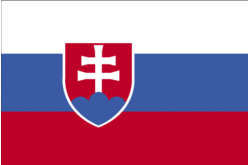 Slovak national flag (Flag of Slovakia)
 Slovakia country profile
 Travel advice for Slovakia
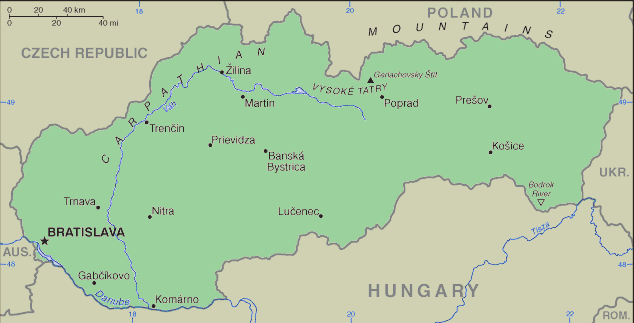 Slovak map