
Natural heritage · Kyrgyzstan · Kazakhstan · Uzbekistan
Western Tien-Shan
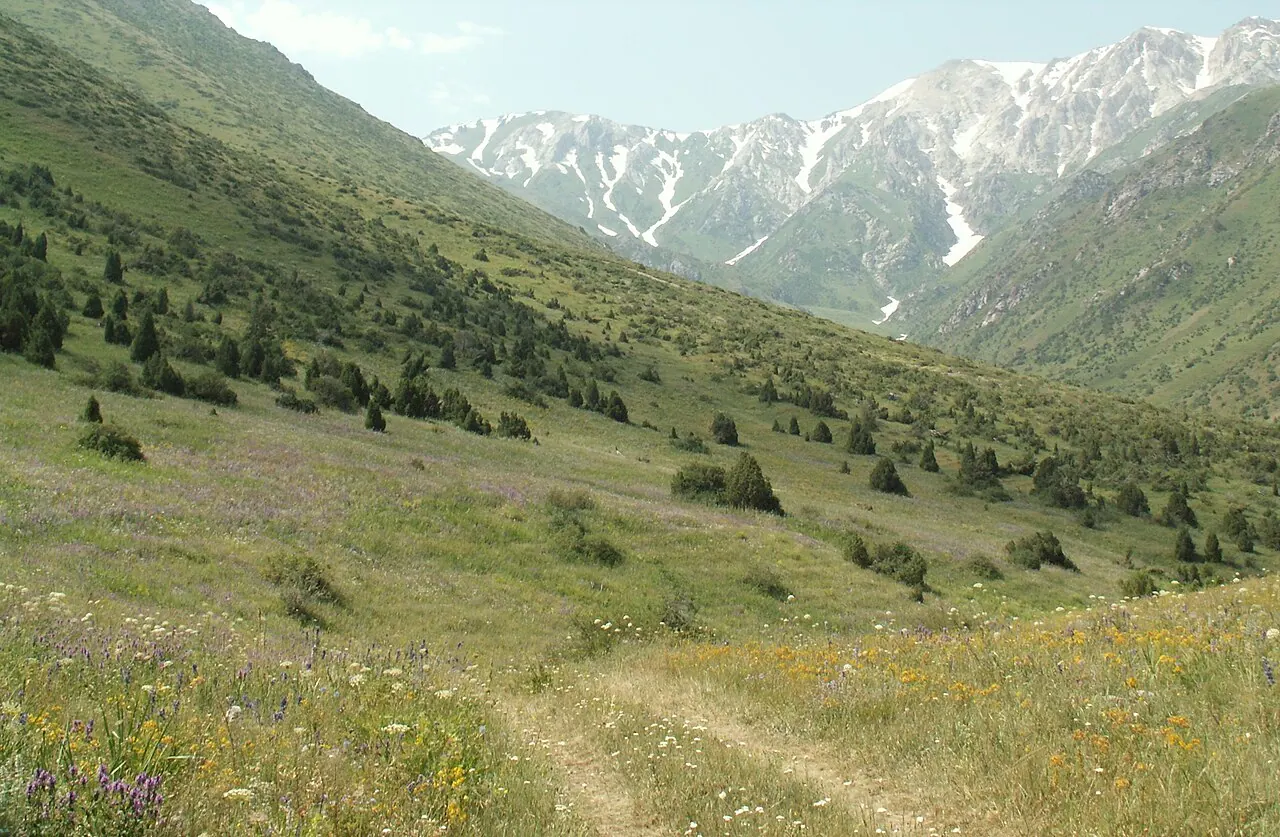
The transnational property is located in the Tien-Shan mountain system, one of the largest mountain ranges in the world. Western Tien-Shan ranges in altitude from 700 to 4,503 m. It features diverse landscapes, which are home to exceptionally rich biodiversity. It is of global importance as a centre of origin for a number of cultivated fruit crops and is home to a great diversity of forest types and unique plant community associations.
Heritage at a glance
- First inscribed
- 2016
- UNESCO region
- Asia and the Pacific
- Selection criteria
- (x)
- Property area (hectares)
- 503,122.9
Why this place matters
UNESCO’s assessment of its heritage significance, adapted in formatting from the source dataset.
Brief synthesis
The Western Tien-Shan is a transnational serial property consisting of 13 component parts located in Central Asia’s vast Tian Shan Mountain system. This mountain system belongs to one of the seven largest mountain ranges in the world and is the largest isolated east-west stretching mountain range globally. It is characterized by a combination of different types of coniferous and deciduous forests, including wild fruit tree species. The property exhibits exceptional ecosystem and landscape diversity across the temperate-arid gradients which exist in this region.
The Western Tien-Shan possesses a globally important diversity of fauna and flora with a considerable proportion of endemic species and communities, as well as a large number of rare and threatened species. It is among the most species rich sites in the Pamir-Tien-Shan Highlands province and close to half of its species are endemic to Central Asia. The property lies within one of the most significant global centres of origin for nut, fruit, and many other cultivated plants of importance to agrobiodiversity (38 important agricultural crops). It is home to a number of wild species related to domesticated fruit plants including wild apples, apricot, pistachio, vine, plum, pear, walnut and hawthorn.
Over 20% of the world’s cereals, vegetable and spice plants, and 90% of the major temperate-zone fruit crops are found in this region. The walnut-fruit forests of the region are considered to be the largest forest of this type in the world. Western Tien-Shan has thus an exceptional value as a centre of origin of cultivated plants.
Criterion (x):
The Western Tien-Shan supports a high diversity of different types of forests and unique combinations of plant communities characteristic of the Mountains of Central Asia biodiversity hotspot. The property hosts an outstanding diversity of plant and animal species, including endemic species and many species of global conservation importance. The property’s main attributes are rare bird and plant species, wild relatives of commercial fruit trees, as well as threatened mammal species. The vertebrate biodiversity in the region of Western Tien-Shan reported at the time of inscription includes 61 species of mammals, 316 species of birds, 17 species of reptiles, 3 species of amphibians and several fish species, with many of these species also reported as occurring in the area of the property.
The occurrence of further species may be confirmed by additional research. The Western Tien-Shan supports a significant number of species of flora and fauna considered as globally threatened at the time of inscription. Several wild relatives of today’s commercial fruit trees occur within the property such as Wild Apricot, Common Walnut, and Sievers Apple, which is present in all component parts, and which is considered the progenitor of vast majority of today’s apple varieties. Other rare species include Crataegus knorringiana, Lonicera karataviensis, Betula talassica, and Spiraeanthus schrenkianus.
Over 20% of the world’s cereals, vegetable and spice plants, and 90% of the major temperate-zone fruit crops are found in the region. Regarding the property’s fauna, the Snow Leopard, Argali and Menzbier’s Marmot are amongst the key species. The endemic Menzbier’s Marmot inhabits territories in all three countries with a population of more than 26,000 was reported at the time of inscription. The Argali is present in most component parts, with more than 500 individuals of two subspecies recorded.
The Snow Leopard uses all but one component part with 20 individuals recorded at the time of inscription, though significant data gaps remained. More than 40 Saker Falcons and around 300 Cinereous Vultures were recorded at the time of inscription, though data gaps remained. Both are present in all component parts. Around 100 Egyptian Vultures were recorded at the time of inscription.
Integrity
The property’s 13 component parts seek to represent and collectively protect the globally significant biodiversity values of the Western Tien-Shan. The boundaries of the inscribed areas and buffer zones may benefit from thorough review to ensure that they follow ecological principles, fully correspond to criterion (x), address habitat connectivity and ensure intactness and wholeness of the Outstanding Universal Value’s attributes. There are integrity issues pertaining to key species of the property’s Outstanding Universal Value. To address such issues, additional research will be important, including identification and mapping of critical habitats of key species supporting the property’s Outstanding Universal Value with a view to incorporating vital ecological components that are currently not included within the boundaries of the property.
In the future, the addition of the most critical habitat for the Menzbier’s Marmot could further enhance the overall integrity of the property.
Protection and management requirements
The protection status of the property’s component parts is considered to be adequate. The majority of component parts are state protected areas of national importance and are protected under the respective national legislations of Kazakhstan, Kyrgyzstan and Uzbekistan. Protected areas included in the property correspond to IUCN Protected Area Categories Ia and II and appropriate protection regimes are in place. Most reserves are strictly protected natural areas, where any use of animals and plants and any economic activities are prohibited.
Access is limited and strictly controlled. Sairam-Ugam State National Nature Park in Kazakhstan, corresponding to IUCN Category II, has four different zones, including a strictly protected zone (Reserve Zone) but also zones allowing visitor access and limited use of nature (Tourism and Recreation Zone and Limited Economic Use Zone). All areas of Western Tien-Shan have their own administration and staff and they are managed by authorised state executive bodies in each country with funding from state budgets. The main pressures to the property’s OUV stem from intensive use, including poaching, cattle grazing, illegal logging, hay collection, and illegal harvesting of flowers.
However, more recent potential threats raise concern regarding the long-term integrity of the property, including from potential tourism, infrastructure and natural resource development projects. Parts of the property are surrounded by populated areas and, as a result, they hold tourism potential which must be carefully managed to optimize benefits and minimise any threats from uncontrolled tourism development. In all the component parts, these threats and pressures are taken into consideration in management plans. At the time of inscription, staff and resources are considered adequate to address threats from tourism.
Ongoing natural hazards and pressures in the Western Tien-Shan include rock falls, landslides, mudslides, avalanches, as well as droughts that exacerbate vulnerability to fires in dry years. As a result of climate change, the habitat of Menzbier’s marmots shifted to higher altitudes. As a serial transnational property, transboundary cooperation and an overarching management framework represent a key protection requirement. At the time of inscription, some initial steps have been undertaken by the three States Parties towards development of a transboundary management framework for the property, including the establishment of a transboundary Steering Committee.
However, greatly enhanced efforts are needed to better coordinate management across the component parts of the property in the three concerned countries. At the time of adoption of this Statement of Outstanding Universal Value, in 2026, transnational cooperation has been formalised through a Memorandum of Understanding (MOU) since 2019, and the Regional Committee of the Western Tien-Shan Transboundary Natural World Heritage site has been established. The Regional Committee is composed of the property’s three States Parties and includes representatives of responsible state bodies, protected areas and relevant international organizations from each State Party. A Joint Action Plan for 2021-2025 and the Regional Management Plan for the Western Tien-Shan World Heritage site: Framework for transboundary management Western Tien-Shan World Heritage site (Kazakhstan, Kyrgyzstan, Uzbekistan) for 2024-2028 have been developed and adopted.
The Regional Management Plan is underpinned by National Management Plans and Management Plans for each protected area covering different periods and developed by each State Party. In addition, joint governance mechanisms, including sustainable financing to enhance coordination, should be reinforced. A joint and regularly updated transboundary database is required to effectively collect and use monitoring data informing reporting and transnational management action.
Places within this listing
This is a serial property with 11 components in the imported record.
View the component places
- Karatau State Nature Reserve (1490-001)
- Padysha-Ata State Nature Reserve (1490-009)
- Sary-Chelek State Biosphere Nature Reserve (1490-006)
- Besh-Aral State Nature Reserve – main part (1490-007)
- Aksu-Jabagly State Nature Reserve – main part (1490-002)
- Besh-Aral State Nature Reserve - Shandalash area (1490-008)
- Sairam-Ugam State National Nature Park – Boraldaitau area (1490-003)
- Sairam-Ugam State National Nature Park – Sairam-Ugam area (1490-005)
- Sairam-Ugam State National Nature Park – Irsu-Daubabin area (1490-004)
- The Chatkal State Biosphere Nature Reserve – Maidantal area (1490-010)
- The Chatkal State Biosphere Nature Reserve – Bashkizilsay area (1490-011)