
Cultural heritage · Tunisia
Village of Sidi Bou Saïd
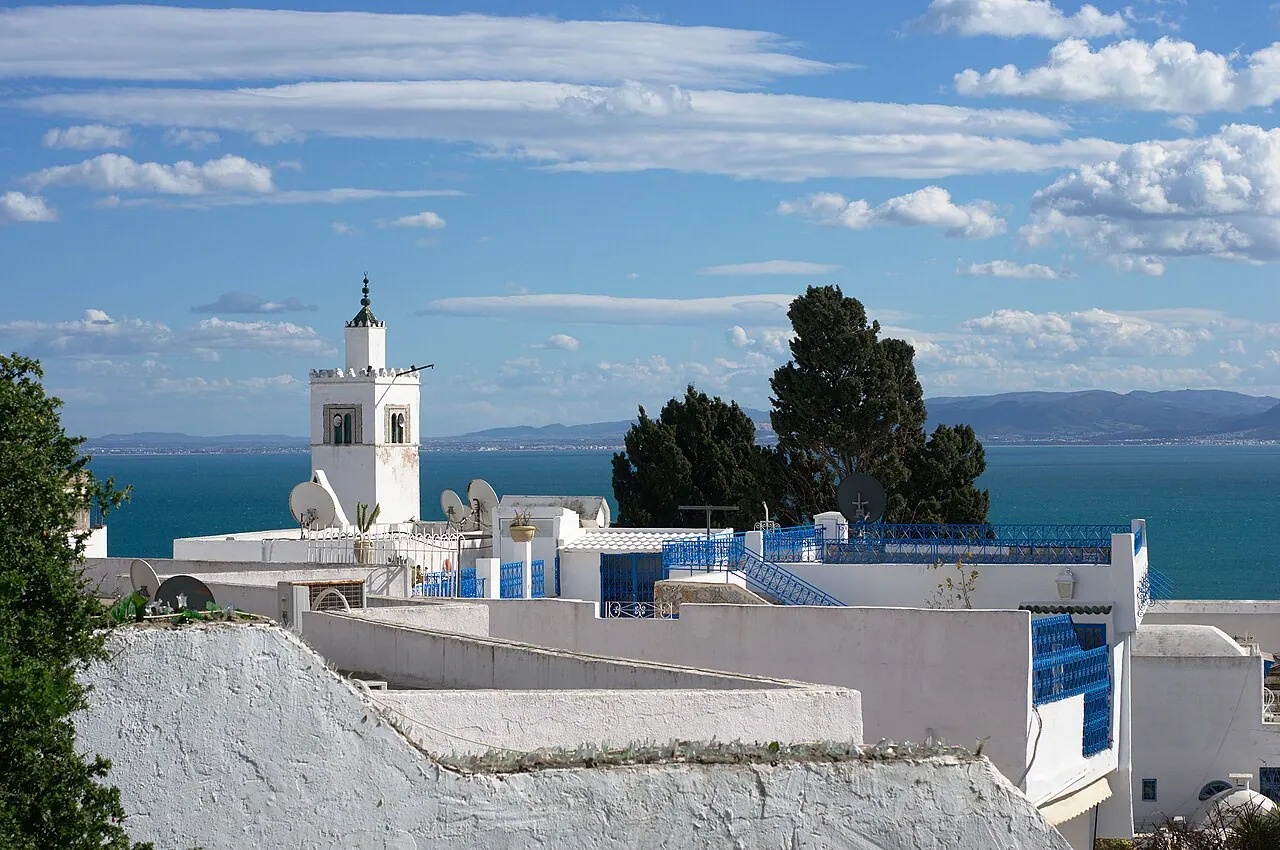
The property is a picturesque village perched on a promontory overlooking the Mediterranean Sea, harmoniously integrated into the cliff topography. It developed around the tomb of a Sufi master and saint, known as Sidi Bou Saïd, who lived in the 12th-13th centuries. Through its architectural fabric and urban planning in symbiosis with the natural environment, its recognisable aesthetic created by emblematic colours, and a mystic aura associated with the Sufi spirituality that permeates the site, the property brings together geomorphology, architecture, and spirituality. It has long inspired artists and continues to attract visitors seeking spiritual serenity.
Heritage at a glance
- First inscribed
- 2026
- UNESCO region
- Arab States
- Selection criteria
- (iii)
- Property area (hectares)
- 76.54
Why this place matters
UNESCO’s assessment of its heritage significance, adapted in formatting from the source dataset.
Brief synthesis
The Village of Sidi Bou Saïd is located on top of a hill overlooking the Mediterranean Sea, in northern Tunisia. It developed as a sanctuary-village as a result of a process of aggregation around the mausoleum of a Sufi saint – Abou Saïd Khalaf Ibn Yahya El Tamimi El Beji, known as Sidi Bou Saïd – supported by successive ruling dynasties, which, from the 16th century onwards, fostered the sacralisation of the place by associating their political legitimacy with the baraka (blessing) of the saint. The Husainid beys (18th-20th century) consolidated this dynamic by building holiday residences in Sidi Bou Saïd and turning it into an elite resort. The property embodies the encounter between the spiritual power of the saint and the temporal political power.
With the religious complex of Sidi Bou Saïd at its heart, the village reflects the traditional Arab-Islamic urban planning around a central place, enriched by the 19th-20th century urban-type residential architecture of the notables.
Criterion (iii):
The Village of Sidi Bou Saïd represents an exceptional testimony to the tradition of village foundations based on a symbiotic relationship formed between the spiritual authority of a saint and the temporal power of a ruling dynasty. It exemplifies in an exceptional way the phenomenon of sanctuary-villages, fundamental to the social and political history of the Maghreb, that developed as a result of a saint’s prestige which provided religious legitimacy to the sovereign, and the sovereign’s patronage which, in return, ensured the perpetuation and prosperity of the saint's sanctuary and village.
Integrity
The property includes the entire historic village of Sidi Bou Saïd, within its 1915 boundaries, excluding a few later buildings which break with the traditional architectural style of the place. The urban morphology and the fabric of the village have been well preserved, and the landscape setting remains largely unaltered, except for the introduction of a marina below the southern slope of the promontory. Other limited instances in which the integrity of the property has been compromised and visual aspects of the site negatively affected are mostly reversible. The site suffers dangerously from instability related to its geological nature and environmental factors.
Developmental pressures are largely under control, but excessive tourism is a major concern that requires strategic reorganisation, as it shows to negatively affect the character of the property. At present, despite changes in the socio-cultural and economic context of the site, the vivacity of Sufi spiritual practices persists.
Authenticity
The property has maintained its morphological coherence and its urban fabric has remained largely unchanged, owing to the 1915 Beylical decree, which helped preserve the village and its historical density. Land division occurred sporadically. The construction of the marina at the southern foot of the promontory modified to a small degree the landscape setting of the property. The mystical practices associated with Sufism remain active and the places of religious practices have mostly retained their original function.
The identity of the village that has shaped its history and culture has been maintained, though it faces increasing threats posed by tourism. The related economic dynamics have already led to some changes in the use of residences within the village.
Protection and management requirements
The property is protected by the Beylical decree of 1915 and the decree 85-1246 of 1985, which provide strong controls against the changes to the spatial organisation of the village, as well as to the fabric and aesthetic of its built environment. The National Institute of Heritage under the Ministry of Cultural Affairs oversees the protection of the property through the Archaeological, Historical and Traditional Arts Heritage Code of 1994. The Institute is also the central body responsible for the management and conservation of the site. The Urban Development Plan for the municipality of Sidi Bou Saïd regulates land uses while incorporating provisions for the protection of heritage, in line with the Territorial and Urban Planning Code of 1994.
The management plan has been prepared for a pilot phase (until 2027) and will be further developed.