
Cultural heritage · Italy
The system of Italian-style condominio theatres of the 18th and 19th centuries in Central Italy
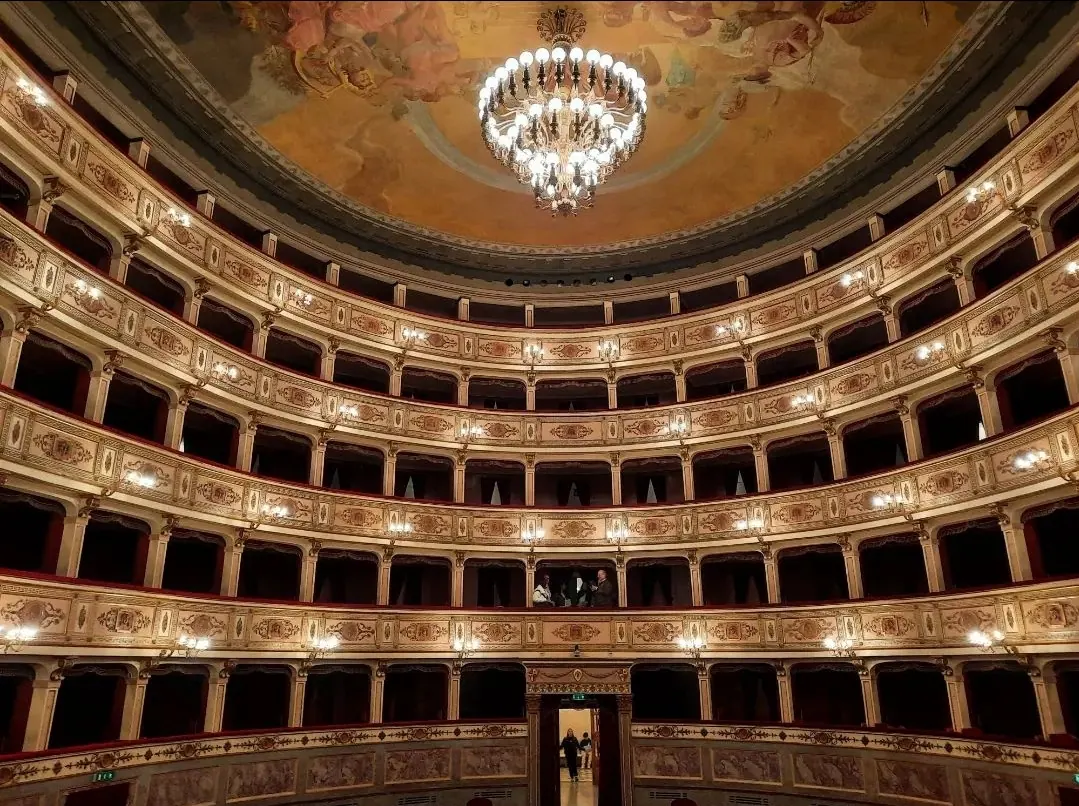
The serial property comprises ten Italian‑style condominio theatres built between the mid‑18th and late 19th centuries across Emilia‑Romagna, Marche, and Umbria in central Italy. Architecturally representative of Neoclassicism with Late Baroque influences, these theatres feature tiered boxes, carefully designed auditoriums for optimal acoustics and visibility, stalls, foyers, ridotti, and historic stage machinery. They embody the innovative “condominio” system, a model of collective ownership and public‑private financing that enabled municipalities and private citizens to collaborate in constructing theatres in small and medium‑sized towns. This system fostered the growth of a widespread cultural network, providing new representational spaces for the emerging bourgeoisie and broadening public access to the performing arts. Located at the heart of historic town centres, these theatres became important civic meeting places, hosting performances and public events and contributing to the formation of public opinion.
Heritage at a glance
- First inscribed
- 2026
- UNESCO region
- Europe and North America
- Selection criteria
- (iii)
- Property area (hectares)
- 4.42
Why this place matters
UNESCO’s assessment of its heritage significance, adapted in formatting from the source dataset.
Brief synthesis
The condominio theatre represents a major evolution in the Italian-style theatre model around the mid-18th and late 19th centuries, marking the transition from being a place for aristocratic entertainment to becoming a cultural institution driven by an emerging bourgeoisie. Based on a unique partnership between public bodies and groups of wealthy citizens, known as società condominiali, this economic model is founded on collective ownership and the sharing of costs. This management structure enabled the wide spread of theatres, particularly in small and medium-sized towns in Italy. By making the financers of theatre projects partners in their design, the condominio model turned these theatres into spaces for architectural experimentation and as economic driving forces for these small and medium-sized towns.
The condominio model thus fostered the development of specific architectural features manifesting themselves in precise adjustments to social spaces (entrance halls, foyer, ridotto), the standardisation of the tiered boxes, the optimisation of sightlines, the development of separate circulation systems, transforming the theatre into a tool of prestige precisely tailored for its users. This model fostered the emergence of spaces for social life where culture belonged to an emerging bourgeoisie. In addition to their artistic purpose, these theatres have also played a role as centres of political awareness, transforming small and medium-sized towns into dynamic social and cultural centres; a function they still retain today.
Criterion (iii):
The system of Italian-style condominio theatres of the 18th and 19th centuries in Central Italy bears witness to the rapid development in town centres of a phenomenon that saw widespread expansion in the 19th century in Italy and Europe, followed by Latin America. These theatres, which first appeared in the provinces of Emilia-Romagna, Marche and Umbria from around the mid-18th century on, were one of the few places where groups of representatives of the emerging bourgeoisie, patrons of the theatres, could gather, and where public opinion was formed. These theatres, financed via the società condominiali involving public bodies and private citizens in the construction and management of these spaces, embody the transition from an exclusive private domain to civic institutions accessible to a wide audience. The condominio theatres of the regions of Emilia-Romagna, Marche and Umbria, part of the former Papal States, enabled the development of innovative solutions for theatres, reflecting the participation of different social classes and testifying to the new social hierarchy.
The longevity of these theatres, which continue to host a wide variety of cultural events today, bears witness to how deeply they are embedded in local community life.
Integrity
The ten component parts comprising the serial property include the most emblematic examples of condominio theatres. The component parts share all of the defining features developed during the three historical periods under consideration, from the early 18th to the late 19th centuries. Each of the component parts continues to serve the purpose for which it was originally created. The component parts are in a good general state of conservation and, when conservation works are needed, these are scheduled.
Authenticity
The serial property meets the conditions of authenticity in terms of form and design, materials, use and function, location and setting. All component parts convey the Outstanding Universal Value of the property through a series of common attributes: the financing model through the società condominiali; the continuity of use; and the physical and spatial features of the Italian-style theatre as codified by condominio theatres. Numerous written and visual sources are able to confirm the authenticity of the theatres of the serial property, providing key information for understanding their history and development. Archival documents, including original plans and those of subsequent restorations demonstrate the care taken with the structures and their decorative elements.
Protection and management requirements
Responsibility for the protection and management of each of the ten component parts of the serial property lies with the national government, and local, regional and municipal authorities. Each component part is protected by town planning regulations and legislation applicable nationally or locally, as well as by public ownership. The main legislative framework is governed by the Cultural Heritage and Landscape Code; Legislative Decree 42/2004 of 22 January 2004, and law 1089/1939 of 1 June 1939. The management system of the serial property is based on the Memorandum of Understanding established between the Ministry of Culture (MiC) and the three regions and municipalities concerned.
This agreement defines the roles and responsibilities of these authorities for the long-term conservation and management of the property.
Places within this listing
This is a serial property with 10 components in the imported record.
View the component places
- Teatro Feronia (1762-008)
- Teatro Bramante (1762-009)
- Teatro dell'Aquila (1762-006)
- Teatro Lauro Rossi (1762-007)
- Teatro Angelo Mariani (1762-001)
- Teatro Ventidio Basso (1762-004)
- Teatro Serpente Aureo (1762-005)
- Teatro Gentile da Fabriano (1762-002)
- Teatro Nuovo Gian Carlo Menotti (1762-010)
- Teatro Giovanni Battista Pergolesi (1762-003)