
Cultural heritage · Australia
Murujuga Cultural Landscape
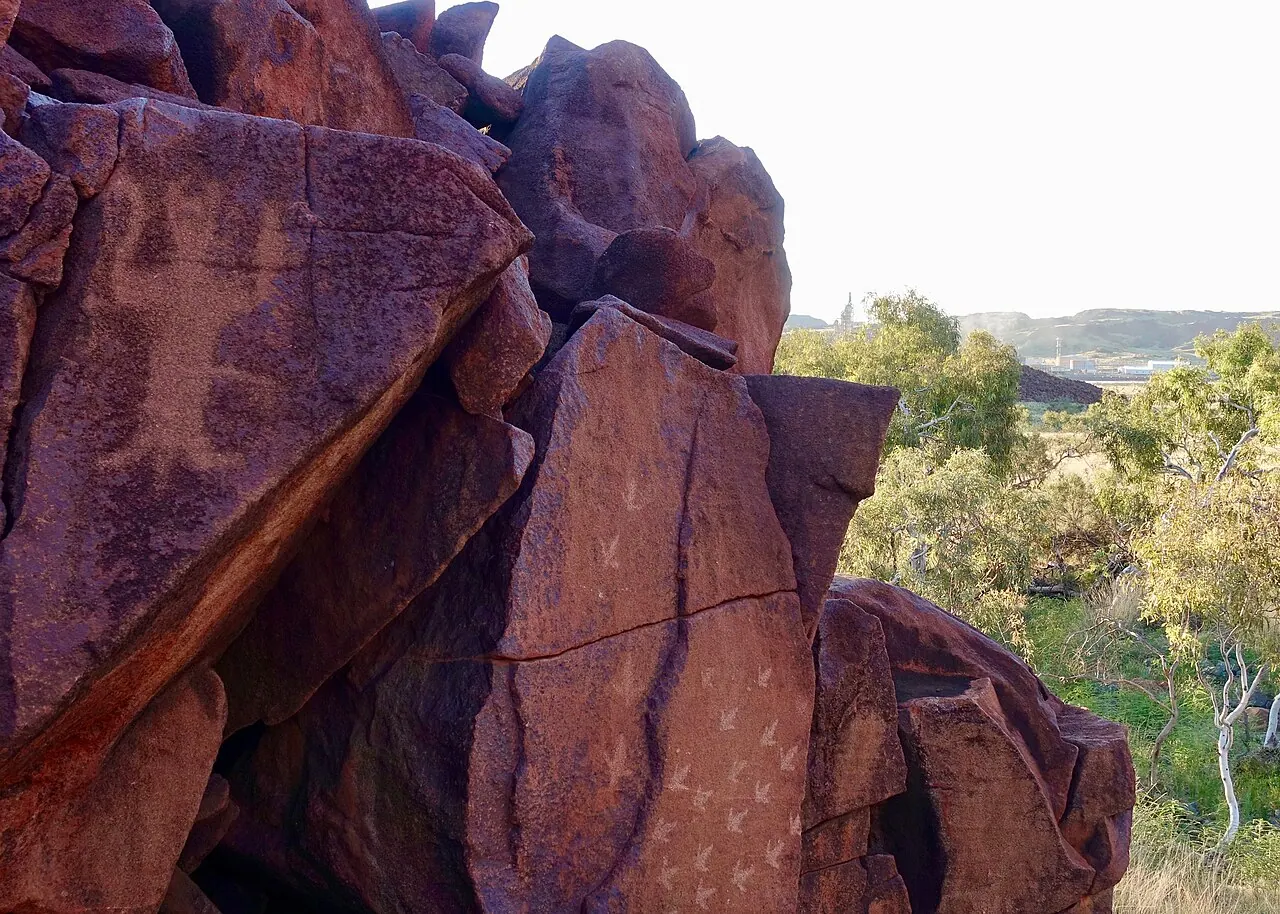
Murujuga is a deeply storied land and seascape located in northwest Australia. It encompasses the Burrup Peninsula, the Dampier Archipelago, surrounding marine areas and the submerged landscape. Murujuga is shaped by the Lore — rules and narratives put in place to create the Country — and the enduring presence of the Ngarda-Ngarli, Traditional Owners and Custodians of the site. The property holds profound cultural and spiritual significance, reflecting over 50,000 years of continuous care and management by Traditional Law that has adapted to the changing needs of Country over periods of dramatic climatic and environmental change. Murujuga is renowned for its dense concentration of archaeological and spiritual sites that reflect the interaction between people and place over thousands of generations. Its extraordinary rock art assemblage records a complex system of Lore and Traditional Law, features unique motifs and demonstrates artistic and technical mastery.
Heritage at a glance
- First inscribed
- 2025
- UNESCO region
- Asia and the Pacific
- Selection criteria
- (i)(iii)(v)
- Property area (hectares)
- 99,881
Why this place matters
UNESCO’s assessment of its heritage significance, adapted in formatting from the source dataset.
Brief synthesis
Murujuga is a deeply storied land and seascape located in northwest Australia. It encompasses the Burrup Peninsula, the Dampier Archipelago, surrounding marine areas and the submerged landscape. Murujuga is shaped by the Lore — rules and narratives put in place to create the Country — and the enduring presence of the Ngarda-Ngarli, Traditional Owners and Custodians of the site. The property holds profound cultural and spiritual significance, reflecting over 50,000 years of continuous care and management by Traditional Law that has adapted to the changing needs of Country over periods of dramatic climatic and environmental change.
Murujuga is renowned for its dense concentration of archaeological and spiritual sites that reflect the interaction between people and place over thousands of generations. Its extraordinary rock art assemblage records a complex system of Lore and Traditional Law, features unique motifs and demonstrates artistic and technical mastery. Murujuga, meaning ‘hip bone sticking out’ is inscribed for its living cultural values as expressed in the creative artwork, stories and its spirituality for Ngarda-Ngarli. The Outstanding Universal Value of the Murujuga Cultural Landscape lies in the traditional system governing it, which manifests in unified tangible and intangible attributes that attest to the use of and care for the land and seascape since Ngurra Nyujunggamu, when the world was soft, the beginning of time.
The petroglyph assemblage at Murujuga is extensive, diverse, and includes motifs of artistic originality, where innovative techniques convey movement and technical skill employed to achieve textured effects. An extensive structure of beliefs and perspectives that incorporates spiritual knowledge, cultural practices and Creation narratives perpetuates the meaning and significance of the petroglyphs and other tangible attributes that occur within the cultural landscape. The deliberate placement of motifs at significant sites within the landscape has great aesthetic impact. The Murujuga assemblage is the most vast and densest known concentration of petroglyphs in the world.
The petroglyphs incorporate visual representations of cultural practices and record history through times of significant climatic and environmental change. The cultural landscape includes evidence of occupation which, in combination with the petroglyphs, stone structures and living cultural practices, demonstrate adaptive human use of land and sea. The continuity of rich cultural connections is evident in the people, beliefs, and Murujuga Cultural Landscape since deep time. These attributes are intrinsically holistic and it is only through their unified consideration that the full narrative of the cultural landscape is understood.
This is a living cultural landscape, under the care and cultural governance of Ngarda-Ngarli, that is testament to cultural traditions, creativity, spirituality and ecological knowledge spanning tens of thousands of years.
Criterion (i):
The petroglyphs of the Murujuga Cultural Landscape demonstrate artistic achievement assembled over 50,000 years. The creative genius of Ngarda-Ngarli ancestors is evidenced in artistic quality, placement within the landscape, and the overwhelming visual quality of the entire ensemble of 1-2 million petroglyphs. The artistic quality is remarkable. There is diversity in artistic expression, including use of naturalism and abstraction.
While some anthropomorphic figures are arranged in complex scenes, others are engraved in distinctive styles as individual motifs. There are abstract static figures; unusual profile figures; as well as standing, running, and squatting figures, some with sinuous limbs, where artists have used profile and perspective to create a sense of movement. Many zoomorphic petroglyphs demonstrate detailed naturalism revealing morphological knowledge of locally and nationally extinct marsupials. Animal footprints denote spiritual paths through the landscape, and the corpus also includes geometric and abstract designs.
The collection of rare and intricate archaic faces, thought to be some of the oldest Murujuga petroglyphs, are amongst the earliest anthropomorphic images on earth. These motifs were produced using complex decorative infill and would have required exceptionally skilled engraving techniques. The petroglyphs are visually outstanding, demonstrate technical skill, and represent multiple phases in the development of regional and local styles. The petroglyphs exist in deliberate spatial relations, established by deep cultural connections between people and landscape, imbued with meaning and associated with spiritual knowledge and practices.
Their placement and content convey an encyclopaedia of cultural knowledge. The Murujuga petroglyphs are a manifestation of creative genius, inscribed in the landscape since deep time.
Criterion (iii):
The Murujuga Cultural Landscape bears testimony to the living cultural traditions of Ngarda-Ngarli and the spiritual relationship between people and landscape that is at least 50,000 years old. Ngarda-Ngarli knowledge, Lore, Law, and culture are expressed through the landscape and in the petroglyph assemblage. The petroglyphs of the Murujuga Cultural Landscape have a central role in the continuing culture of Ngarda-Ngarli through storytelling that connects Country with creation stories. New generations learn cultural traditions through the observance of Law, artistic practices like song and dance, as well as the performance of particular actions at places of spiritual power within the landscape.
Ngarda-Ngarli fulfill cultural obligations to look after the Murujuga Cultural Landscape. Ngarda-Ngarli know there are possible harmful effects if cultural obligations are neglected. The petroglyphs, stone structures and Ngarda-Ngarli’s cultural beliefs all provide testimony to a living cultural tradition. Petroglyphs are a permanent reminder that Traditional Lore is inscribed into the landscape.
Stone structures and archaeological sites are a permanent inscription within the landscape of the practice of Law, the social division of space and adaptive strategies of stewardship within a dynamic environment. The creation narratives, jinna (‘songlines’), spiritual places, and thalu (increase sites) are fundamental to Ngarda-Ngarli understanding and management of nature. The natural attributes are a reminder of continuing traditional management of the land and seascape over thousands of generations. The stories, the resources and spirit of the land are alive and as important to Ngarda-Ngarli today as they have been for at least 50,000 years.
Criterion (v):
The Murujuga Cultural Landscape exemplifies the combined works of nature and humankind. The relationship between Ngarda-Ngarli and the landscape is evident in the petroglyphs, archaeological record and, importantly, contemporary knowledge and culture. Material evidence and Ngarda-Ngarli living culture attest to continued use of the landscape over millennia, including periods of significant environmental and climatic change. The inextricable integration of cultural and natural attributes embodies the enduring relationship between people and nature, offering a unique example of human adaptation to ecological and cultural transition and environmental and cultural stewardship.
The long history of adaptation to change illustrates a balanced, symbiotic relationship with nature, demonstrating the deep and sustainable connection of Ngarda-Ngarli to Country and exemplifying the traditional system perpetuated by Ngarda-Ngarli which governs the landscape as a whole. The landscape reveals a creation narrative of climatic change, culminating in rapid sea level rises that shifted the coastline approximately 160 kilometres, so the arid rocky ranges became an archipelago. The petroglyphs of Murujuga provide a detailed record of the ecological transition, illustrating traditional ecological knowledge. Ngarda-Ngarli witnessed and adapted to change, modifying rituals and the landscape, including middens, quarries, standing stones and fish traps.
The landscape includes Australia’s earliest known domestic stone structures, as well as submerged occupation sites. Ngarda-Ngarli continue to sing jinna connecting the land and seascape. The Murujuga Cultural Landscape is an outstanding example of human interaction with the environment over at least 50,000 years. The landscape is patterned by this long-term presence persisting through irreversible environmental and climatic changes.
The cultural landscape includes petroglyphs, stone structures and living cultural practices, which evidence adaptive utilisation of land and sea and continuous Ngarda-Ngarli custodianship of the Murujuga Cultural Landscape since deep time, through present time and for Ngarda-Ngarli into the future.
Integrity
The Murujuga Cultural Landscape is an intact and demonstrative example of human creativity, spiritual associations and continuous human interaction with a dynamic land and seascape. The integrity is sustained through Ngarda-Ngarli cultural practices and active management. All attributes that convey Outstanding Universal Value are within the boundary of the property and in a good state of conservation. Tangible attributes are whole and intact, and intangible cultural associations remain strong.
Based on surveys, assessment and consultation, the boundary has been designated to exclude deteriorated lands and the property conveys all the values of the Murujuga Cultural Landscape. The attributes of the Murujuga Cultural Landscape include a vast petroglyph corpus; stone structures; archaeological sites; sites of spiritual and cultural significance; as well as sites demonstrating a continuation of land and sea use spanning millennia. Significant features are in good condition and impacts of deterioration processes are controlled through monitoring and management. Relationships are maintained through continuing traditional custodianship of the Murujuga Cultural Landscape.
The resilience and persistence of Ngarda-Ngarli in advocating for heritage protections and ensuring continuity of traditional practices, despite colonisation, mean that the intangible heritage values of the Murujuga Cultural Landscape are intact and continuing.
Authenticity
The Outstanding Universal Value of the Murujuga Cultural Landscape is truthfully and credibly expressed in petroglyphs, stone structures, and living cultural practices of Ngarda-Ngarli. The authenticity of the Murujuga Cultural Landscape is deeply intwined with tangible and intangible elements that reflect the traditions, beliefs, perspectives and cultural practices of Ngarda-Ngarli.
Authenticity
here encompasses truth in the design and substance of the petroglyphs and the credibility of the cultural traditions. The authenticity reflects Ngarda-Ngarli cultural understandings and ontologies, extending back through all recorded time. The connection between people and landscape is inscribed into the landforms, as artworks carved and etched into the rocks and stone structures created for a range of traditional uses. The Murujuga Cultural Landscape has evolved over at least 50,000 years of human occupation, and the attributes convey an authentic sense of place reflecting the continuing and dynamic presence of Ngarda-Ngarli.
Creative genius is credibly and truthfully expressed in the petroglyphs, demonstrating originality in technique, form and design. Continuing cultural traditions coherently accord with knowledge conveyed by the petroglyphs. Motifs relate to traditional community identity, relationships, and responsibilities. Lore and Law define knowledge and responsibility through prescribed rules that govern economic, cultural, social and ceremonial interactions.
Ngarda-Ngarli work to ensure intergenerational transmission of language, traditional knowledge and continuity in protecting and caring for the Murujuga Cultural Landscape.
Protection and management requirements
Protection of the Murujuga Cultural Landscape is a cultural obligation of Ngarda-Ngarli. Ngarda-Ngarli protocols for protecting the landscape through customary governance are practiced alongside contemporary management techniques. The joint managers of the Murujuga Cultural Landscape are the Murujuga Rangers, Elders and Directors, managed by Murujuga Aboriginal Corporation, and the Western Australian Government. The Outstanding Universal Value is protected through the care, control and management of Ngarda-Ngarli, who are supported by a comprehensive legislative framework.
Ngarda-Ngarli have obligations and authority under both traditional ‘Lore’ and Australian ‘law’. Traditional knowledge guides management and Murujuga Aboriginal Corporation’s consent is sought prior to development within and outside of the property. Protection and management of the Murujuga Cultural Landscape includes working with managers of adjacent lands to monitor and manage impacts of existing development. The Murujuga Rock Art Strategy establishes the long-term framework to protect Murujuga’s petroglyphs from the impacts of industrial emissions, and the continuous and consistent implementation of the Murujuga Rock Art Monitoring Program and the Environmental Quality Management Framework is essential for the effective protection of the petroglyphs.
The World Heritage values of the property are recognised as a ‘Matter of National Environmental Significance’ under the Environment Protection and Biodiversity Conservation Act 1999. A majority of the land area of the property is also protected through Australia’s National Heritage List. Cultural heritage within the Murujuga Cultural Landscape is further protected by the Aboriginal Torres Strait Islander Heritage Protection Act 1984 and the Western Australian Aboriginal Heritage Act 1972.